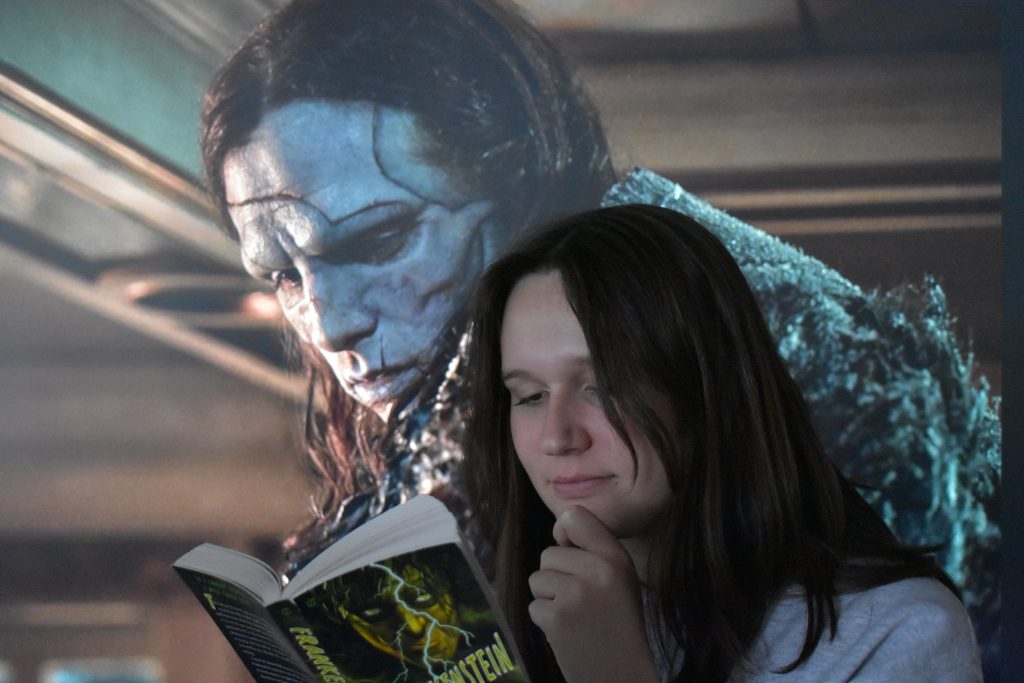
Guillermo del Toro’s Frankenstein examines who is truly a monster, landing in favor of the one initially given that designation. photo by Evelyn Jackson
A comparison of three different versions of Frankenstein.
Thomas Jefferson High School students in AP English Literature are currently reading the classic novel Frankenstein. This coincides with the release of Guillermo del Toro’s new movie adaptation, so it seemed like a good time to see how Mary Shelly’s work has changed over time. There have been many changes made to this classic story through the years, from the original 1818 edition to Shelley’s revised 1831 edition and finally to this year’s movie adaptation.
Spoilers ahead!
The first major change between the book versions and the movie comes in the form of the framing narrative. In the book, the whole novel is supposedly being transcribed by Robert Walton, who is on a voyage in the Arctic, in letters to his sister. The 1831 edition adds a few passages of reflection from Walton, about the glory of nature and his desire to succeed and triumph in his explorations, but it mostly stays true to the 1818 edition. The movie, however, removes the character of Walton entirely, and condenses the timeframe between Victor Frankenstein being found by the ship and him beginning his story. This change removes some of Victor’s initial characterization, as Walton views him very favorably and converses with him a great deal in the time Victor is recovering on the ship, leading the reader to begin the story with a positive impression of its protagonist. Instead of beginning the story with a reflection on the wonders of nature and exploration, del Toro chooses to start his movie with a scene of terror and violence, reflecting the themes that are explored as the plot progresses.
Victor’s family life is also greatly altered between versions. In both editions of the book, he has a pleasant childhood, raised by loving parents who both live into Victor’s adulthood. But in the movie, Victor’s home life is troubled. His mother dies in childbirth when Victor is only a teenager, and his father is abusive, desiring to mold Victor into his image and punishing his son if he makes a mistake. Victor only has one sibling in the movie, William, who has been aged up and combined with Victor’s other brother in the book, Ernest. The most important changes the movie made are changing Victor’s relationship to Elizabeth and removing the character of Clerval. In the 1818 edition, Elizabeth and Victor are cousins, and are raised together after the death of Elizabeth’s mother. In the 1831 edition, Elizabeth is a poor orphan discovered by Victor’s mother, who then adopts her. In both, the Frankenstein parents intend for Victor and Elizabeth to marry. The movie makes it so that Elizabeth is engaged to William, inciting a forbidden romance between the two, at least on Victor’s side. Henry Clerval is a childhood friend of Victor’s in the novel, and one of his most steadfast companions. By removing the positive influences of Victor’s home life, the movie isolates him, enhancing his singular focus on the reversal of death.
Victor’s schooling and experiments are also much changed. Instead of spending decades on his studies, as in the movie, Victor progresses in his education rather quickly, deciding to begin investigating life and death after only two years of study. The descriptions that follow of his experiments, and his philosophical musings on the nature of life itself are entirely unchanged between the two versions of the book. However, this process is radically different in the movie. For one, it takes up rather more screentime than equivalent page time in the books. Secondly, and more importantly, in the movie Victor shares his discoveries with others, both the scientific community and his family. In the book, he rejects the idea of telling anyone about his creation, first out of obsession with his goal, then out of disgust at his imagined failure, then out of fear that he will be thought of as a madman. The movie invents the character of Herr Hollander, who supports and funds Victor’s endeavors until it is revealed that he desires Victor to use his discoveries to save Hollander’s life, after which he dies when Victor refuses.
As with many adaptations of Frankenstein, the 2025 movie invents an explanation for how Victor was able to reanimate a human body: the galvanic power of electricity. In the book, Victor specifically refuses to explain how exactly he gave life to his creation, contributing to the theme of the danger of hubris and of man playing God. However, there is a line that suggests Victor’s interest in electricity, presumably leading many who are adapting the book to use this as Victor’s method. Once the creature has been revived, Victor’s response differs greatly from book to movie. In the book, he is horrified by his creation, and abandons it, only to immediately fall devastatingly ill and need to be nursed back to health by Clerval for months. (Book Victor tends to faint at the slightest provocation, something not carried through to the movie.)
The movie initially makes it out to seem like he has failed in his endeavors, but when it is revealed that he succeeded and his creation has life, he is in awe of it and resolves to raise and care for it. Until, that is, he realizes that his creation is not instantly a genius, and is learning things at a very slow rate. This may be because Victor is a terrible teacher, and abuses the creature when he does not learn as quickly as Victor would like, in a direct parallel to how Victor’s father behaved. When he sees that Elizabeth, whom he loves (is obsessed with), is more sympathetic to his creation than she is to Victor himself, he abandons the creature. More than that, in fact, he sets his laboratory on fire while the creature is trapped in the basement, hoping to kill him. This creates a Victor Frankenstein that is much more cruel and callous than the one in the book, who is still incredibly self-centered and dramatic, but not vicious like in the movie.
The change that has the greatest impact on the themes of the movie versus the book comes in the form of whom the creature intentionally kills. Both versions of Shelley’s book explore what it means to be a monster, and how people’s actions and choices affect others. Del Toro, on the other hand, claims that it is Victor who is the true monster, instead of it being the creature—as portrayed in many other movie adaptations—or both, as Shelley originally concluded. The creature in the movie kills no one except in self-defense. Never once does he do harm first, it is always the humans who attack first. The deaths of Elizabeth and William are accidental; Elizabeth throws herself in front of a bullet Victor shot at the creature and William is inadvertently thrown against a bannister as the creature defends itself from being attacked. Del Toro’s creature is inherently good, the inarguable hero of the movie. In fact, as William is dying he lays this out to Victor, telling him outright, “You are the monster.”
Shelly, on the other hand, examines both Victor and his creation in a much more complex light. The creature is capable of both reflectiveness and eloquence when it comes to his existence, and yet he intentionally murders four of Victor’s loved ones just to spite his creator. Still, he is incredibly sympathetic, as his life has been defined exclusively by hardship and rejection. Yet this does not justify his actions. Victor, on the other hand, is an incredibly irresponsible scientist, and worse, he does not take accountability for his actions, even when doing so would save a life (Justine, who is framed by the creature for the murder of William and then hanged, something that does not happen in the movie). But Victor also loses nearly every single person he loves, people who are innocent of the crimes he committed against his creation. And so he, too, is sympathetic.
This is not to say that del Toro’s movie is bad. It is different from the source material, certainly, condensing and altering plot points and changing the central themes of the story, but it doesn’t seem as if he set out to create an exact copy of the original. He had a different message he wanted to convey through the story, and he did it effectively. Not to mention, the movie is absolutely gorgeous. But it is useful to note the changes between each telling of Frankenstein, and to examine what they say about the story, the creator, and, ultimately, the reader or viewer.