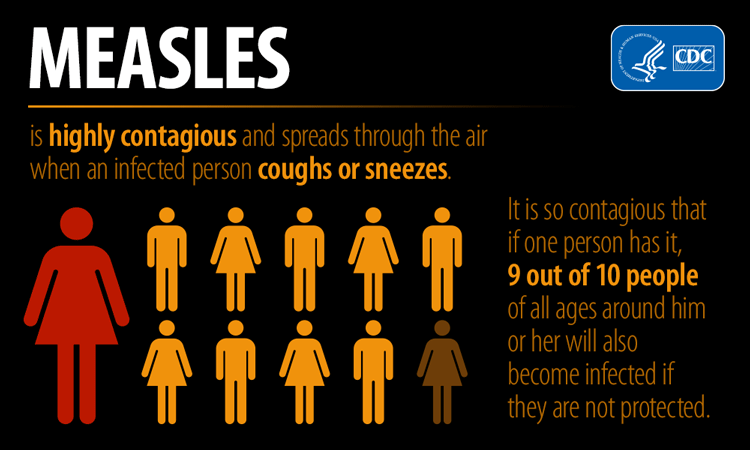
CDCs’ educational infographic highlights the high risk of the measles virus, explaining that the virus spreads through the air when it infects a person. photo by CDC
Measles poses a threat in the Denver Metro Area.
An international traveler diagnosed with measles spent days visiting heavily crowded areas across Boulder, Westminster, and Lafayette, triggering an alarming public health alert for thousands of residents in north metro Denver. State health officials quickly released a list of exposure sites that reads like a popular weekend itinerary. From the rooftop of Avanti Food and Beverage to the open-air crowds at the Pearl Street Mall and the busy Denver Gem and Mineral Show, the highly contagious virus had plenty of opportunities to find new hosts.
Measles is not a new enemy for Colorado, but it is a stubborn one. Historically, the state has struggled with vaccination coverage, often ranking among the lowest in the nation for kindergarten MMR (measles, mumps, and rubella) immunization rates. According to (source),of the 25 confirmed cases in Colorado so far this year, 22 were entirely unvaccinated and 19 occurred in children and teenagers.
The measles virus is deceptively ordinary at first. Measles symptoms mimic a standard cold, with common symptoms of high fever, cough, a runny nose, and watery eyes. According to the Colorado Department of Public Health and Environment, these initial signs are quickly “followed by a rash that usually starts several days later on the face and spreads down the body.”What makes measles a threat to humans is how easily it spreads through crowded areas. It is an airborne contagion, meaning it rides on microscopic respiration droplets when an infected person talks, coughs, or sneezes. The virus hangs in the air for up to two hours after the sick individual has left the room, and a person has over a 90% chance of contracting the measles virus after exposure.
The economic effects of a public health crisis have a severe impact on local businesses. This is in part because when well-known places are listed as exposure sites, foot traffic in the area decreases. With tables left empty and a large number of reservations canceled, restaurants quickly suffer losses. At the same time, local clinics and hospitals come under enormous financial pressure. To deal with the situation, these healthcare facilities have to put into place strict isolation measures, and trace out thousands of possible people who have been exposed. Pressure on public resources increases immediately. A study by the Centers for Disease Control and Prevention (CDC) showed that in Colorado, “two single imported measles investigations exceeded $68,000 in costs, requiring 1,191 personnel hours.”Business owners have to cope with these consequences while public health teams work long hours to control the threat.
Ultimately, this recent outbreak serves as a stark reminder that public health is a shared responsibility. Colorado’s low vaccination rates leave its communities and economy highly vulnerable to preventable diseases. As businesses face lost revenue and public health resources are stretched to their limits, the solution remains clear. The best defense against the threat of measles is ensuring widespread, community-wide immunization, ensuring high vaccination rates across Colorado is not just a personal health choice, but the ultimate defense needed to stay secured.