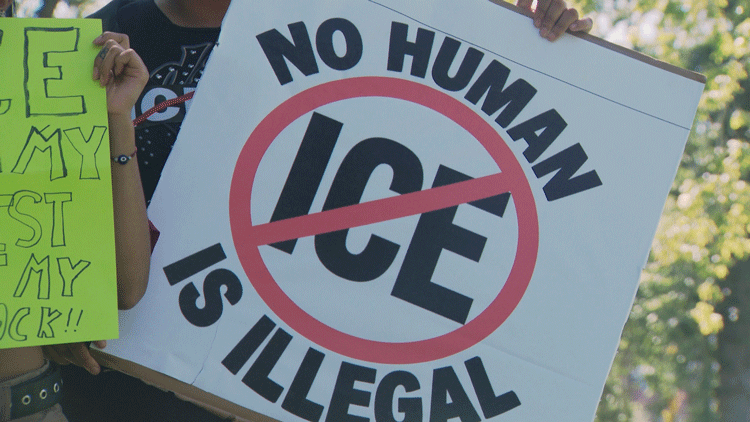
A powerful protest sign holding Anti-ICE sentiment. photo courtesy of 9News
The new generation of Latinos shows that activism runs in the culture.
Latino history runs deep and is intertwined with American history. Latinos have fought for their right to exist on their own land for centuries. Recently, the new generation of Latinos has been making its voices heard. Across the nation,a spark of student-led protests has ignited mirroring the historic Chicano walkout at West High School in the 1960s. With history constantly repeating, how different is the new generation of Latinos?
The most notable progression of civil rights for Latinos in the United States happened largely around the 1960s. At this time, there was a severe lack of Mexican representation in history curricula, despite Mexico’s historical ownership of modern U.S. territories. Some schools even went as far as banning students from speaking Spanish. Over time, Latino students became frustrated with the erasure of their heritage, which led to massive student-led walkouts. A majority of these walkouts happened in East Los Angeles, with a few others happening in Colorado and Chicago. On March 20, 1969, Colorado saw one of the largest and most violent student-led protests. Students from West High School decided to stage a walkout, marching to a neighboring high school which gained them even more supporters. The protest had gained so much traction that the Crusade for Justice, a group founded in Denver to help the fight for Chicano rights, decided to show their support by rallying behind the students. With nearly 22,000 students participating in these walkouts state-wide, educators finally caved in and decided to give the students a chance to plead their case. Because of these protests, students were able to implement Chicano literature and history into their curriculum.
Recently, many Latino students are again holding several walkouts, something that was unheard of just a couple decades ago. Unlike the activists of the 1960s, the new generation no longer has to fight to gain their rights, but rather has to work on protecting their rights. In one instance, students from over 200 high schools in Colorado have participated in a protest against the brutality of ICE. Similarly to the Chicano students of the 60s, the youth of today will continue to fight for what they believe is right. They have shown that they are capable of rallying together and making sure their voices are heard.
However, unlike past generations, more and more students are given the opportunity to take a course on Latin American History (LAH).This curriculum is fundamental for students, especially for Latino scholars. It allows them to fully understand their history, which was something that was unheard of just a couple decades ago. However, the benefits of LAH classes extend beyond Latino students. LAH classes serve as a way to educate people on the forgotten history of America. This class helps highlight the unseen struggles of Latin Americans. Yvette Orin, the Latin American History teacher at Thomas Jefferson High School, shared that she sees how the new generation has not given up hope on a brighter future for Latinos. “Our generation [is] actually living really good lives…and your generation knows it’s not good enough. They know that we still have to fight for equality, for our rights, and to be seen.”
At their core the generation who carried out the Chicano movement and youth of today are really no different. They’re both motivated to make a change in the world, pushing past the barriers of their time. Both generations saw the mistreatment of their communities and decided that a change had to be made. So even when basic rights are given, the fight for justice isn’t over.